SSL certificates are getting shorter, down to 47 days. What changes for your site?
The maximum SSL certificate lifetime drops to 47 days by 2029. Here's why, what changes for your site, and why manual renewal is over.
Your certificate will expire a lot more often
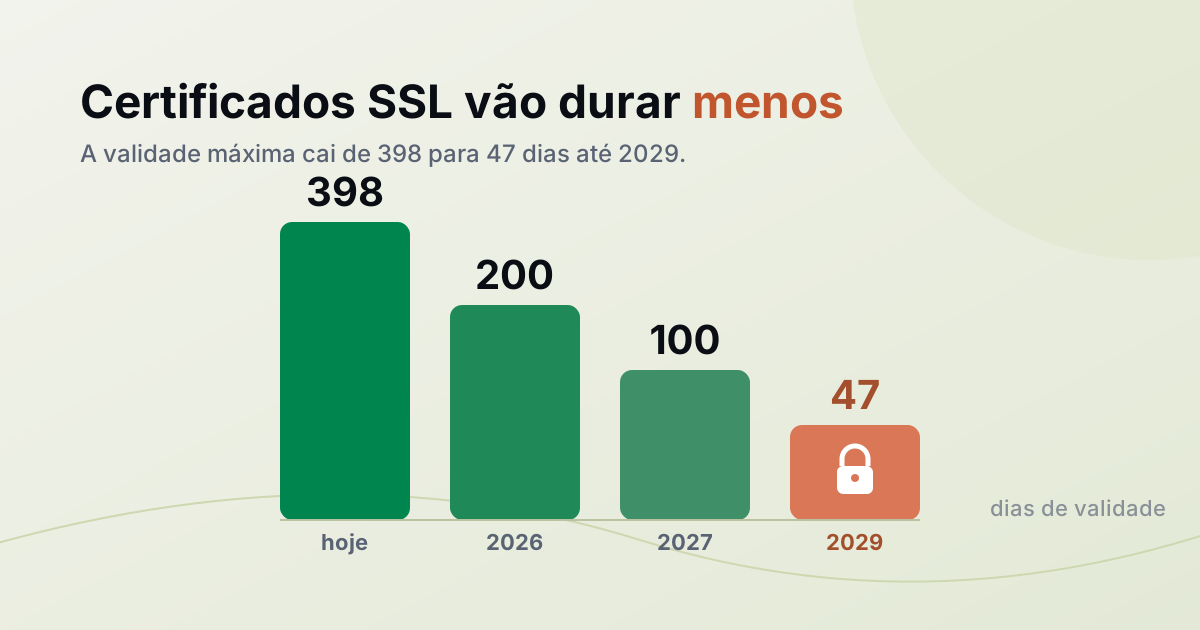
Every HTTPS site has an SSL/TLS certificate. It's what closes the padlock and proves the visitor is really talking to your domain. That certificate has an expiry date, and today it can last up to about 398 days (thirteen months). That's changing: over the next few years the maximum lifetime will drop in stages down to 47 days.
The news alarms anyone who renews certificates by hand, but there's another side: if your certificate is already issued and renewed automatically, you won't notice any difference, because the system swaps the certificate on its own, as many times as needed. The problem is only for anyone still relying on a manual process. Let's go through what's changing, why, and what to do.
From 398 to 47 days, in stages
In April 2025, the CA/Browser Forum (the body where browsers and certificate authorities set the rules for certificates) approved a gradual reduction of the maximum lifetime of publicly trusted SSL/TLS certificates. Here's the schedule:
| From | Maximum certificate lifetime |
|---|---|
| Today | 398 days (about 13 months) |
| March 2026 | 200 days |
| March 2027 | 100 days |
| March 2029 | 47 days |
Alongside the lifetime, the reuse window for domain validation (the check that the domain is really yours) shrinks too: in the final stage, that validation has to be redone every 10 days. In practice, each renewal becomes almost a fresh issuance, which is exactly why the process has to be automatic.
These rules apply to publicly trusted certificates, the ones any site on the open internet uses. A company's internal certificates, used only on its own network, follow different rules.
Why shorten the lifetime?
It sounds backwards to make certificates last less, but the logic is security. A certificate is an identity with an expiry. The longer that window, the bigger the exposure if something goes wrong: if your site's private key leaks, or a certificate is wrongly issued for your domain, that compromised certificate stays valid for the whole period. With a short lifetime, the damage clears itself in days, because the certificate simply expires.
The mechanism that was supposed to handle this, revocation (i.e. "cancelling" a compromised certificate before its expiry), never worked well in practice. Browsers often don't check revocation, or ignore it when the check fails. Shortening the lifetime is the more reliable route: instead of relying on a cancellation that may not be honored, the certificate is short-lived by nature.
For the technically minded: this is why the ecosystem is dropping OCSP. Let's Encrypt stopped including the OCSP address in certificates in May 2025 and moved to CRLs, and already offers 6-day short-lived certificates (generally available since January 2026). Certificates of 7 days or less are exempt from carrying revocation information: the short lifetime is the revocation.
What it means for your site
The most direct consequence is frequency: at 47 days you renew the certificate about eight times more than today; with Let's Encrypt's 6-day certificates, the swap is almost continuous. Doing that on a calendar, by hand, stops being viable: it's only a matter of time before someone misses a date.
And missing one is costly. An expired certificate doesn't "degrade" the site: the browser blocks the page with a "Your connection is not private" warning, before any content loads. To the visitor, the site has simply stopped working, with the same kind of error screen that scares people off. The shorter the certificate, the more chances for this to happen if renewal isn't automatic.
The good news repeats: this is a process problem, not a money problem. The automation that handles the 47-day cycle is the same one that handles the 6-day cycle. Anyone already renewing automatically has nothing to do.
How to get ready
What about domains that only redirect?
A domain that only redirects also needs a certificate: it's what lets the redirect happen over HTTPS, with the padlock. If that domain is on Redirect-301, its certificate is issued and renewed automatically, via ACME. Shorter certificates change nothing for you: no date to track, no renewal to run. It's the same principle we covered in registrar domain forwarding without HTTPS: the service handles the certificate for you.
In fairness, this isn't unique to Redirect-301. Any setup with automatic renewal (your hosting, Cloudflare, certbot on your own server) handles the shortening the same way. What matters is not depending on a manual process.
Frequently asked questions
How long is an SSL certificate valid today?
The maximum lifetime of a publicly trusted certificate is about 398 days (thirteen months). That cap drops to 200 days in March 2026, 100 days in 2027, and 47 days in 2029.
Why will certificates last only 47 days?
Security. The shorter the certificate, the smaller the exposure if a key leaks or a certificate is wrongly issued. Since revocation (cancelling a compromised certificate) isn't reliably enforced by browsers, shortening the lifetime is the safer alternative.
Will I have to renew my certificate all the time?
Only if you renew by hand. With automatic renewal (ACME, used by Let's Encrypt and most hosting), the swap happens on its own, however short the lifetime. You don't need to do anything.
What happens if the certificate expires?
The browser blocks the site with a "Your connection is not private" warning, before the page loads. To the visitor, the site is down. That's exactly what automatic renewal prevents.
Will this get more expensive?
It doesn't have to. Automatic certificates via ACME, like Let's Encrypt's, are free. The real cost of the shortening is operational, having an automatic process instead of a manual one, not licensing.
And a domain I only use to redirect?
It still needs a certificate to redirect over HTTPS. On a redirect service like Redirect-301, the certificate is issued and renewed automatically, so the shortening asks nothing of you.
The certificate is the system's problem, not yours
Shorter certificates are good for everyone's security, and invisible to anyone who automated renewal. If you have a domain that redirects, leave the certificate to the service: set it up in the Redirect-301 dashboard and follow the steps in the configuration guide.
Keep reading
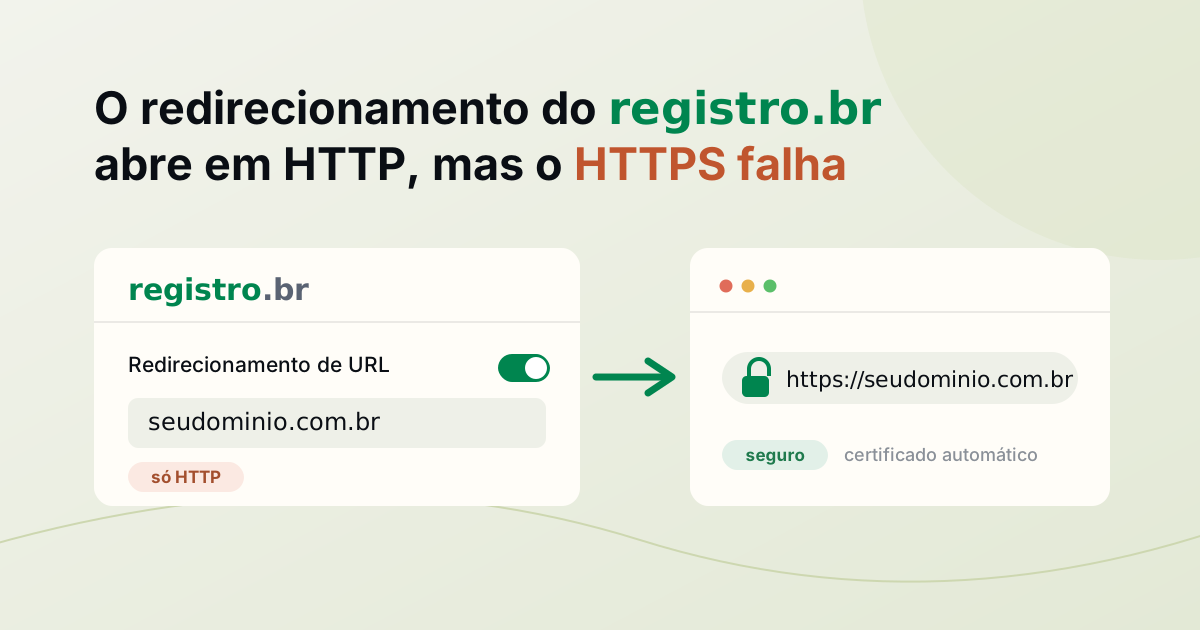
Domain forwarding has no HTTPS? Why it happens and how to fix it
Some registrar domain forwarding redirects on HTTP but fails on HTTPS. Here's why it happens and how to redirect with an automatic certificate.
Chrome now warns before opening sites without HTTPS: is your domain ready?
Since Chrome 154 (October 2026), Chrome asks before opening a public site without HTTPS, even domains that only redirect. Here is how to check yours.
HTTPS and the domain without www: why the root needs a redirect
Browsers hide "https://" and "www", so people type just mysite.com. Here is why that address needs HTTPS and a redirect, and how to check yours.
Need help?
Feel free to reach out to us with any questions. We're here to help! Scan the QR code or click the button below to join our WhatsApp group.
Open WhatsApp →